2010 in review

Thanks to all of you for reading my blog, I am “on fire,” according to WordPress. Here’s some stats if you’re interested. I always find it fascinating how this program monitors all the views of my blog.

I will post for real sometime today before boarding a plane to Santiago, Chile. Promise. Again, thank you all for reading! Happy New Year!

__________________________________________________

The stats helper monkeys at WordPress.com mulled over how this blog did in 2010, and here’s a high level summary of its overall blog health:

Healthy blog!

The Blog-Health-o-Meter™ reads This blog is on fire!.

Crunchy numbers

Featured image

A Boeing 747-400 passenger jet can hold 416 passengers. This blog was viewed about 4,600 times in 2010. That’s about 11 full 747s.

In 2010, there were 16 new posts, growing the total archive of this blog to 39 posts. There were 164 pictures uploaded, taking up a total of 40mb. That’s about 3 pictures per week.

The busiest day of the year was August 16th with 82 views. The most popular post that day was Raising Birds for Meat.

Where did they come from?

The top referring sites in 2010 were fireroastedcatering.com, mail.yahoo.com, themeatmarketgb.com, guides.library.umass.edu, and google.com.

Some visitors came searching, mostly for rawson brook farm, whale tale, farming for justice, baby goats, and rawson brook farm monterey ma.

Attractions in 2010

These are the posts and pages that got the most views in 2010.

1

Raising Birds for Meat August 2010
2 comments

2

About Hannah April 2009
5 comments

3

Women Farmers July 2009
1 comment

4

An Extraordinary Dinner August 2009
4 comments

5

First Training at Rawson Brook Farm Monterey, MA April 2009
2 comments

1 Comment

Filed under Uncategorized

Stories of my Jewish Heritage

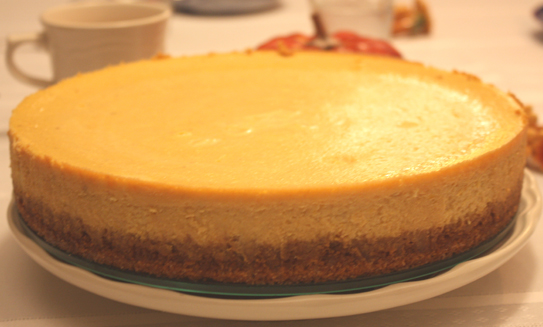
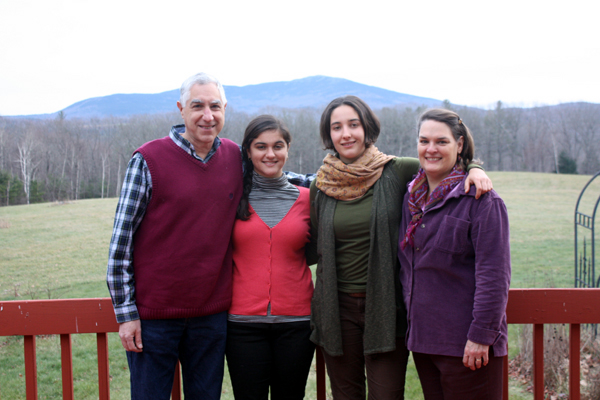
There is an endless list of things to be thankful for on this bitter cold windy night without running water. I sit by a warm fire with plenty of wood stacked high to last all winter. I shared a Thanksgiving meal with each side of the family. I ate until my belly ached, then walked around the block to make room for more pumpkin chévre cheesecake. I listened to a Great Aunt who I met for the fist time on Friday tell us stories about her upbringing as a Jewish woman. We laughed together as a family, simply because life is better that way.

The winter is for recharging our batteries after a long season of hard work. The garden is put to rest and we are forbidden to take food from the earth now that the ground is frozen. We go to our root cellars, freezers and shelves of canned goods grateful for putting up so much delicious food in August and September.

This time, in addition to frozen fruits and vegetables, I have an abundance of chicken and goat meat. I have begun to wonder if my devotion to raising, processing, and eating food is at all connected to my heritage as a Jew. Listening to 93 year-old Aunt Sarah talk about her mother’s cooking, I’ve come to realize how deep my relationship to food has always been. Of course we all have stuff around food and diet. And even though I always had plenty to eat, I pick up on my ancestor’s fear of not having enough to eat because it is deeply rooted in our heritage.

Grandma Gladys, Great Grandparents Parents, and Aunt Gloria

Deprivation of good, whole, healthy food is a major fear I have inherited. I wonder, too, what being deprived of culturally appropriate foods after emigrating to this country was like for Jews. Could any of this be related to my often overzealous food projects? I stock up on food not only because I enjoy learning how to preserve the harvest and eat well all year, but could there be some hidden terror around starvation that I consequently inherited as Jew? There could be, but regardless, there is nothing wrong with my strong passion for all aspects of food. It’s hard to know if I belong to a culture of food having grown up in the U.S. That’s why I am committed to creating my own rituals and looking at Jewish culture around food.

My Father with his Mother

“Every Passover my mother would bake a cake. Now, you know how difficult that is considering we don’t use any flour on Passover,” explained Aunt Sarah. “But my mother’s cakes were always this tall,” she demonstrates by raising one hand about eight inches above the other.

My Father and Uncle Richard with their Aunt Sarah

Pride is the only word that comes to mind for this story. Just like Aunt Sarah, as you all know, I also enjoy sharing about my cooking projects. I am proud too, for my accomplishments over the last few years in regards to sustainable food production. And I am thankful for a family that supports my endeavors.

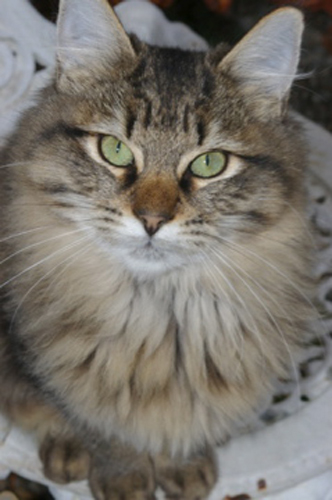
I can’t neglect to share the three sisters I am thankful for: Mia, Misty, and Micah! Cuddly kitten heaven over here at the farm.

1 Comment

Filed under Uncategorized

The Three Sisters

El Maíz, Los Frijoles, La Calabaza

Corn, beans, and squash are three plants that can be grown together. Each one benefits the other- this is called companion planting. First, you plant the corn and wait for it to be a few inches high. Then, the pole beans are planted in a circle around the corn stalk, hopefully climbing up the stalk for support. Once the beans have sprouted, plant the squash, with the intention of shading out weeds with its large leaves. Corn also uses a lot of nitrogen to grow, so having the beans close by will “fix the nitrogen,” or put it back into the soil for next season.

I tried this at a community garden with some success, but mostly it became a cluttered mess of plants that were more fun to look at than harvest. Maybe I need to practice again because timing and space are key. In our garden, we just plant them separately to make weeding and harvesting easier.

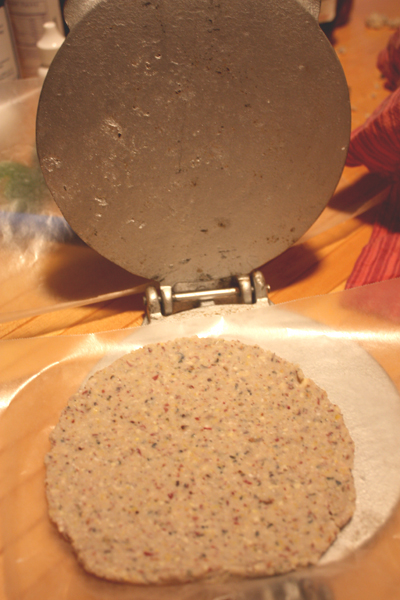
We prepared the three sisters for a Mexican themed dinner one evening to celebrate the harvest. Susan and I grew a multicolored hard kernel corn called Painted Mountain from FEDCO seed company. Once the corn had dried out, we took the kernels off, cooked them in water and pickling lime to remove the husks, then ground them with a grain mill to make flour for tortillas.

These were the most beautiful multi colored tortillas I’ve ever seen. Specks of blue, purple, yellow, pink, and red. We borrowed a friend’s tortilla press and Craig lightly fried them in oil. Mark shredded the queso fresco, a soft white cow cheese.

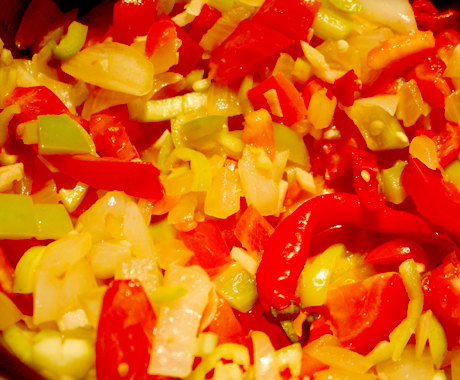
Susan cooked the dried tiger-eye beans from last summer with peppers, onions, and spices. She also made a fresh tomato salsa with cilantro and lime juice. We grew five varieties of hot peppers (Siberian, Hungarian, Jalepeño, Grandpa’s and Cayenne). So, we had to test each one for their heat and then I eventually made a hot pepper jelly, which I declare inedible for being way too spicy. Maybe it will make a good pesticide next year.

¿Qué más?

¡La calabaza! I made a butternut squash soup with caramelized onions and cilantro to garnish. It was simple: boil potatoes, carrots, and squash until soft then I blended it with melted butter, maple syrup, and a little water. After reheating it on the stove, I added salt and pepper to taste. ¡Que rico y delicioso!

We finished with spicy chocolate tapioca. I must admit, the texture of tapioca does not appeal in the least ever since I can remember. However, this was a fine finishing touch that I think I would eat again. So long as chocolate is involved, I will eat it.

I must not forget the margaritas: José Cuervo tequila, orange liquer, and lime juice. We learned that taking small sips every so often is advised despite such a divine drink. Otherwise, I don’t think we would have made it to the dinner table.

¡Buen Provecho!

3 Comments

Filed under Uncategorized

Evisceration Station

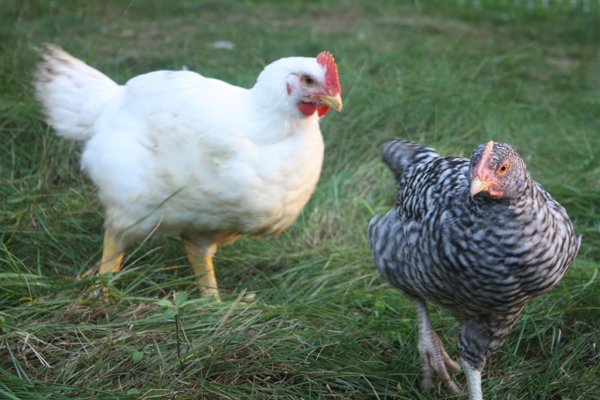
It is one thing to watch a cabbage grow from seed to table, another to watch a live animal. I had killed only one chicken prior to deciding to raise 20 meat birds this summer. Nine weeks into the project, I had 18 monstrous chickens and one odd ball Barred Rock Rooster named Einstein. He was the only one that acted like a chicken, pecking, scratching, foraging in the grass for bugs. Apparently chickens are very social animals because Einstein still layed around most of the day, like the Cornish X Rocks.

Since introducing him to the hens, he has learned to lead a more active lifestyle. At first, the hens terrified him. He stayed by the woodpile all day waiting for me to feed him grain. The hens would run over to check out what special treatment I gave him, devoured his food, and tipped over his water. The next day he ventured out to the bush and hid in there until nightfall. By day five he figured out he wasn’t quite as small as he thought. He followed the girls around leaving a 10 foot safety zone. Now, he knows the route and even has a girlfriend. “The Dude and Dud Duo” stand together all day. Americauna (the hen that doesn’t lay her blue eggs) is being courted by Einstein.  He’s actually very sweet for a rooster, so far. But, if he starts pecking the hens or showing any aggressive behavior towards me, he will become soup. End of story.
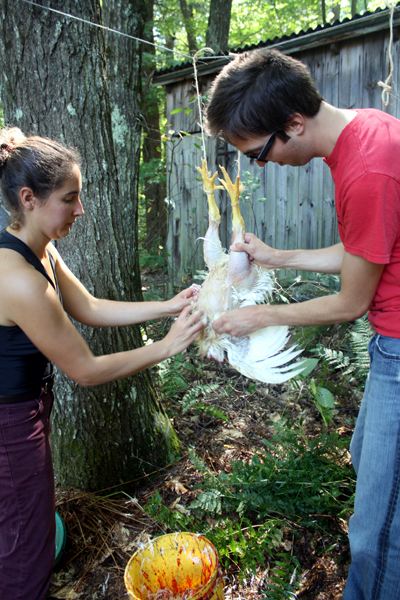
The butchering went very well. Susan, Craig and I processed four birds behind the cabin to experience backyard chicken processing. It took over three hours because we hand plucked. With Susan’s instruction, by bird four I could eviscerate on my own. For me, killing a chicken is not emotionally difficult. It feels like a natural instinct I was born with. I enter some kind of numb, mechanical place where the job has to be done. It is simple. You can’t back out and get upset when you have a chicken by the feet in your left hand and a knife in the right. It’s over so quick and the end result is too tasty and nourishing to pass up.

The worst part, we all agreed, was the smell. To remove the feathers you scald the bird in 145-degree water for less than a minute. Partially cooked skin and manure is not too pleasant. Just another reason to appreciate homegrown chicken that much more.

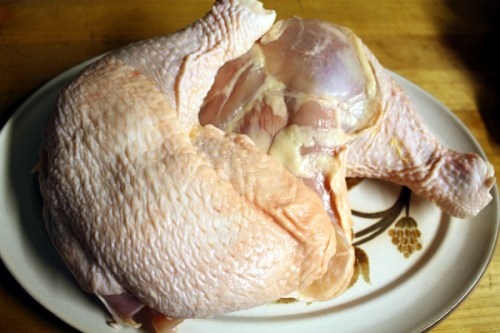
After the seven-pound birds cooled in cold water, they were moved to the fridge for at least a day before freezing. Craig offered to cook lunch for the three of us a few days later. It took two hours of roasting to cook the whole chicken. He stuffed it with the best stuffing I’ve ever had (sorry Mom). The stuffing was cooked in my chicken stock (made from the gizzards, necks, feet, and garden carrots, leeks, onions, parsley) and contained a wild mushroom a friend gave me called “chicken of the woods.”

I asked Craig, “why did you put chicken in the stuffing?”  I was fooled by the mushroom’s chicken-like appearance and texture.

The vegetable: steamed brussel sprouts covered in butter.
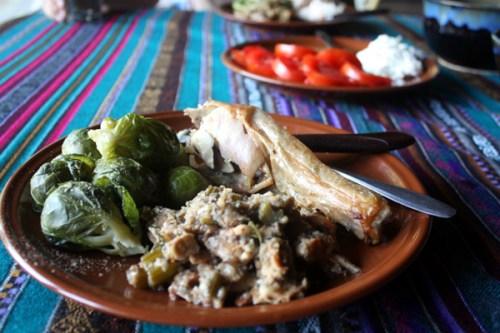
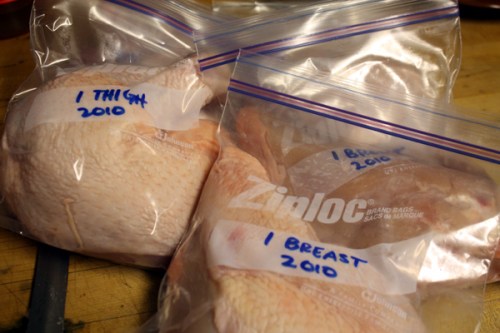
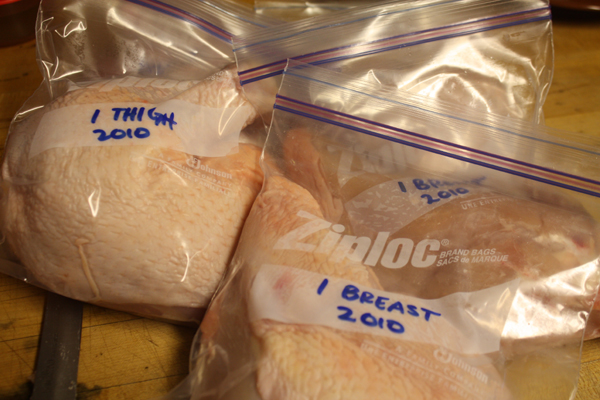
Cooked to perfection, yes, this was worth the work. Tender, moist, and full of flavor, I can never buy a conventional chicken again. Good thing my freezer is full of them! I cut up some of the birds to freeze thighs and breasts so I can have smaller portions in the winter. I thought the work ended once the chicken was in the fridge, but no! I made about 10 quarts of chicken soup from all the leftover pieces.

The rest of the birds I brought to Great Barrington where a local farmer has a processing facility. 14 birds took about 20 minutes. The automatic plucker- best invention ever. Dressed weight ended up between eight and nine pounds. They are like small turkeys! I was at the evisceration station gutting chickens for over three hours.
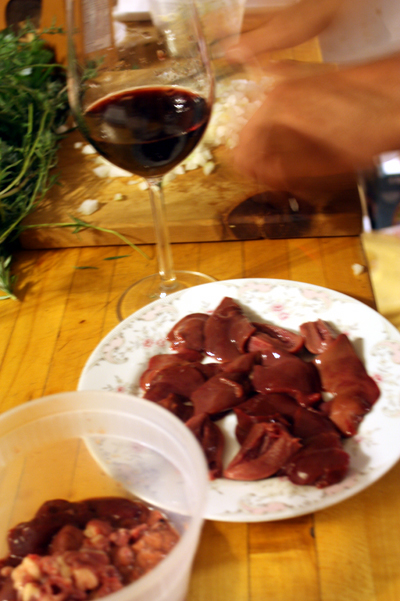
Liver N' Onions

We processed about 80 of his organically fed chickens and they came out to between four and six pounds. This is a little scary, since they were the same age as mine, but I fed non organic Blue Seal Chick N’ Game Bird Crumbles. I went through almost eight 50 pound bags at $17 each. Organic grain costs anywhere from $22-25 per 50 pound bag. If I were selling my chickens, I would have butchered them between 7 and 8 weeks rather than 9 because the lb. or grain to lb. of meat is less efficient after 8 weeks. But, since this is homestead style, I wanted as much meat per bird as possible. It was less about the cost.

Why didn’t I feed them organic grain? Mostly, I was greedy and wanted more meat. These birds are designed to eat what I fed them, and grow much slower on organic feed. I didn’t feed them antibiotics or hormones, either. Organic grain would have cost about $65 more, and we would have ended up with less meat. It was a decision I had to make. Here I am raising conventional birds in a non-conventional setting. They had happy lives roaming free on fresh grass every day. When they got coccidiosis, I treated them because I didn’t want them to suffer and die.
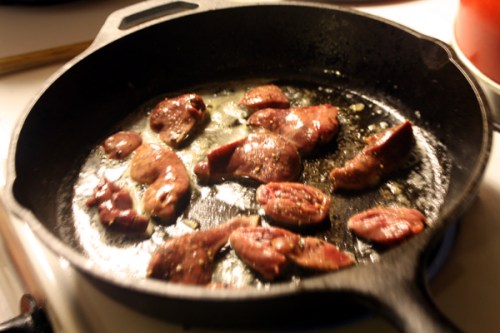
Frying Liver in Butter

What I am learning is that it’s sometimes not practical to be “organic” as defined by the USDA. Let’s assume I’m not referring to the over usage of drugs in factory farming, but small scale and homestead operations. This is tricky, but here is my current understanding- may it continue to evolve.

When raising livestock, if they get sick I would attempt to treat them so they recover. At the goat farm, we are not certified organic. If a goat gets mastitis (infection of the udder), she will be in pain and suffer if we don’t give her an antibiotic. If we were a certified organic dairy farm, Susan would not be able to treat her goats with antibiotics/pain killers/ fever reducers if they got sick. If she did, she would not be able to use that goat’s milk for one year. She would be forced to sell her sick animal to a non-organic farm or put her down because it can’t even be in the same herd with the ‘organic’ goats.

We do not over medicate because the goats rarely get sick since they are taken good care of and live in spacious clean barns. Like a child, we treat them and usually within a few days they are healthy again. However, we cannot use the milk of a sick goat. There is a milk-withholding period for each drug, varying from three to seven days. This means we don’t add the milk to the bulk tank when she is sick or for several days afterward. We also test the milk for antibiotic residue before adding it back to the rest. I never thought I’d say this, but here I go: Antibiotics, when used sparingly and only in necessary situations, are one of the greatest medical breakthroughs.

2 Comments

Filed under Uncategorized

Still Diggin’ the Good Life

Do you ever get that feeling when a few positive things line up together that you must be doing something right? It doesn’t happen often enough, but when it does, you know it. Things just fall into place. I think to myself, yes, I am doing exactly what I should be doing. Instead of running that tape in my head of “You really should be doing this,” or “If only I had done this,” or “My life would be more meaningful if I…,” I start to notice how well my life actually is going. It’s like the tape stops, flips over, and starts new. I get to feel good about everything for that moment.

This morning I got home from milking goats around 9 a.m. with no energy to cook breakfast, do three days worth of dishes, or feed the chickens. It was one of those days that had hardly begun and I already wanted to crawl back into bed. I know you have been there, too. Alas, too many responsibilities to tend and eating a healthy breakfast of eggs and a potato stir-fry gave me some energy. Fine, I’ll keep on going, despite really just wanting to collapse on my futon.

I did what I do every morning like most of us, check my email, read the news. Little did I know my mood was about to change completely. It’s not every morning that I see a photo of myself in the NY Times. In fact this is a first. There I am placing labels onto the cups of cheese trying not to think about the fact that a NY Times photographer is aiming her camera straight at me.

Recognition and appreciation for my work- it feels really good. Here’s a link to the article in last Sunday’s paper.

http://www.nytimes.com/slideshow/2010/08/16/travel/20100822LOCOVORE-2.html

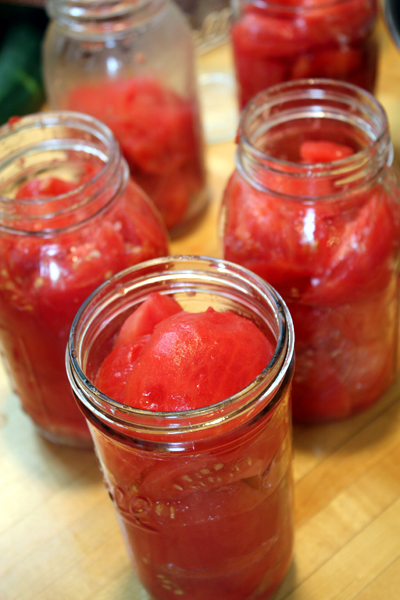
August has been very full of colorful vegetables, stunning flowers, and sweet fruits. I have canned pickles, dilly beans, peaches, and tomatoes. I pop blueberries in my mouth throughout the day and savor the occasional raspberry from the new plants we put in the garden this spring.

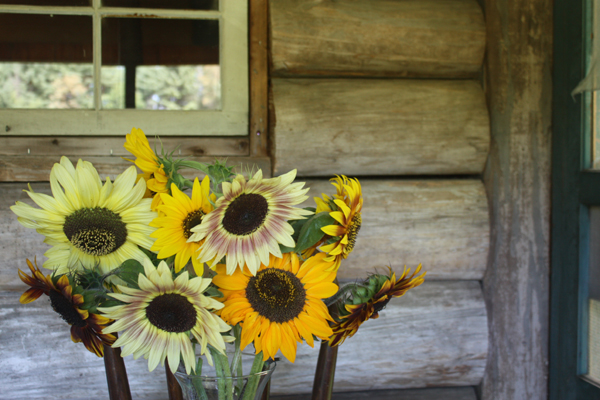
Ah, the garden. It is so huge and can be intimidating. The sunflowers stand about 14 feet tall and some are blowing over in the wind. Everything is doing incredibly well we can’t keep up with all the food, so the chickens get the overly ripe tomatoes and baby goats nibble on cabbage leaves and broccoli.

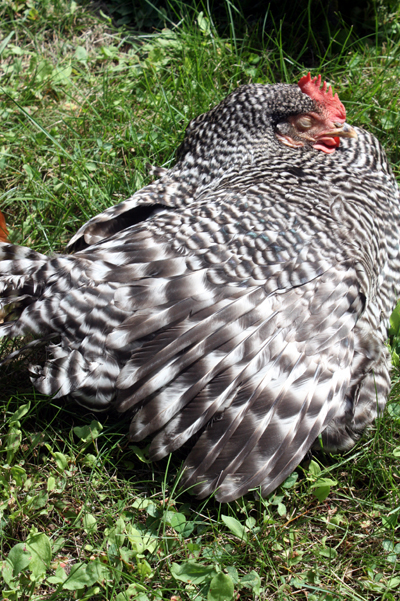
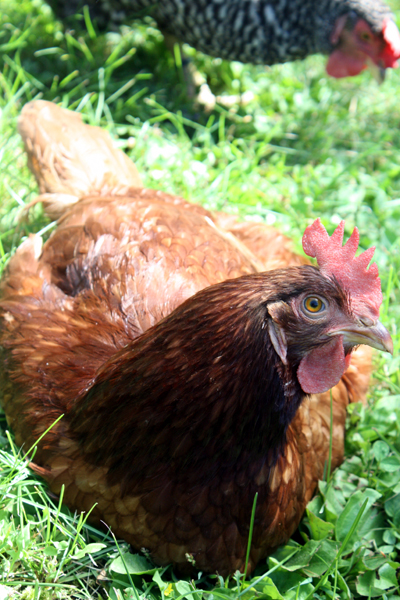
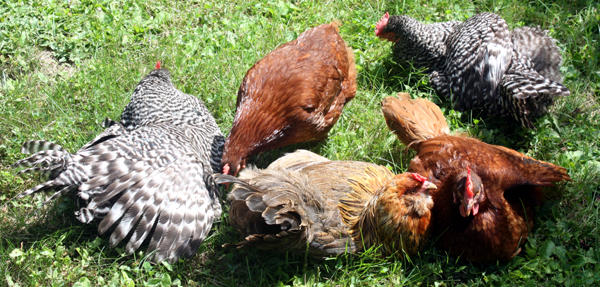
The hens are still as happy as can be roaming free all day and following me wherever I go in hope of a treat. Maybe a mushy peach or a stale rice cake.

Unfortunately we lost one member of the flock, Buff. She was lame after her leg started bothering her and I couldn’t watch her suffer much longer. Now the strong group of five are without their blonde beauty, but appear to be getting along quite well.

The meat birds are almost 8 weeks old and will be ready to be processed soon. They are very fat and can hardly walk, however they seem to enjoy lounging around the pasture. I see a parallel between the giant sunflowers that topple over and these chickens, which cannot walk after 10 weeks old because they are too big for their legs. I’ll let you know how they taste. You can dine with me through the photos. Or maybe you will be lucky enough to be at the dinner table making a toast to the chicken, who sacrificed himself to nourish our souls.

1 Comment

Filed under Uncategorized

Raising Birds for Meat

I am at the end of a long chapter in this meat bird raising project. The chicks are almost four weeks old and only live between eight and ten weeks so they are reaching the middle of their lives. How relieved I am to be finally sitting in my hammock after removing all the chick brooders from my porch. It is once again my space for reading, napping, eating, and staring out into the yard. I am finding my inner peace and clarity now that the babes have “flown the nest.”

A peeping box with 25 living animals arrived at the post office early Wednesday morning of July 7th. I rushed home to quickly throw together the brooder that I had prepared, but all the different parts were scattered around my yard. In less than 15 minutes I had an old metal sap tank, heat lamp, wood shavings, newspaper, feeder, waterer, and thermometer. I dipped each of their beaks into the broiler booster water (vitamins, minerals, electrolytes) so they would know to drink after a long hard trip from Iowa.

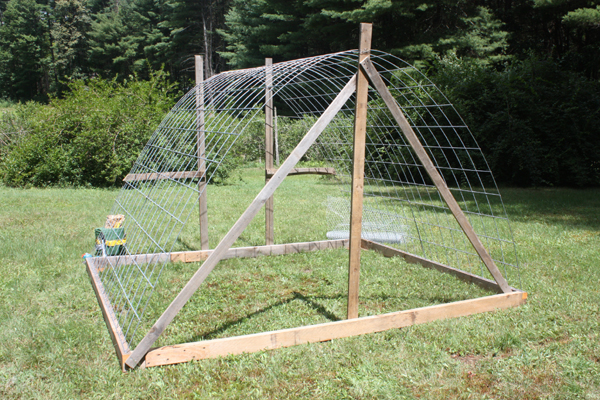
Cattle Panel Coop Frame

Remember that brutal heat wave? It was 90-95 degrees during the day so the chicks were a little stressed out. They like it at that temperature, but I worried they would overheat with the heat lamp. I didn’t monitor the temp. religiously enough and it fluctuated too much the first week so I lost a few chicks. I also fed them cheap name brand grain because Blue Seal was on backorder for medicated chick starter. I ended up switching to Blue Seal Chick and Game Crumbles the following Tuesday, which agreed with them quite well.

Susan could see my frustration after losing a few chicks. I wondered what I was doing wrong and automatically blamed it all on myself. I’ve never raised chicks before, and doing it alone is very challenging. I asked some friends for advice along the way, but left the rest up to nature. One chick was obviously suffering greatly for over a day and was peeping every time is took a breadth. It drove me insane. No matter how hard I tried to ignore the anguish, it’s all I could hear day and night. Nurturing the little guy back to health was an option, so I attempted to bring it inside on a heating pad and give it water.

At 10 p.m. I was still giving him attention. There is a certain point where you just have to let go, not get emotionally attached, or use too much energy trying to save dying chicks. I could not take it anymore. He was suffering and so was I. The decision was made- it was time for him to move on and be at peace. This was the first and only animal I have ever put down without the intention of harvest.

I sobbed. Not for the baby chick, but more for me. It felt enormously pitiful. Here one minute, and gone the next. His little body looked peaceful. End the suffering. I was relieved. It was over and I could focus my attention back on the birds still alive.

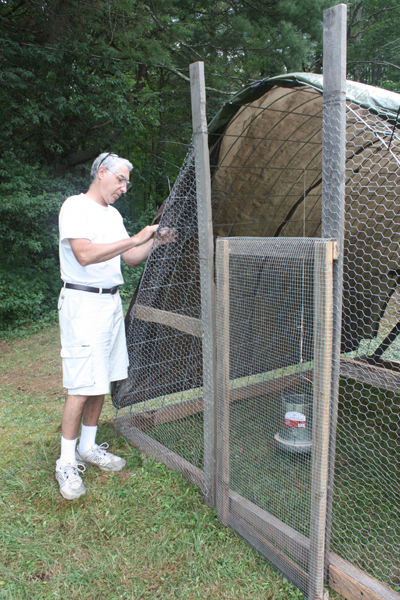
Dad Helps Put Chicken Wire Around Coop

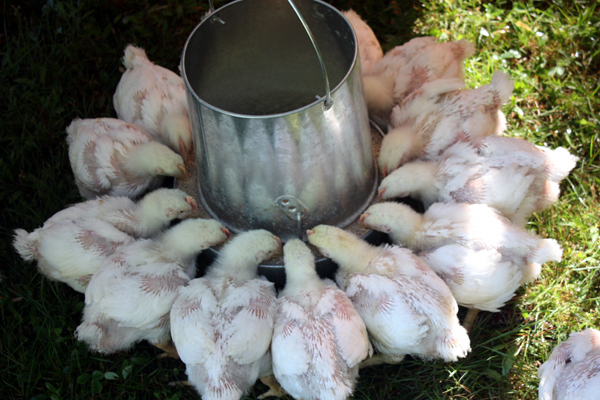
Cornish X Rocks grow incredibly fast. I was not prepared. By the second week I had to improvise quickly. I created another chick brooder and divided the group: 14 and 7. Phew. But not for long! They outgrew both brooders in another week. I couldn’t keep their bedding clean enough and they started knocking their waterers over causing wet bedding, not good for chicks that want to be warm and dry. It was time for them to move outside, onto grass.

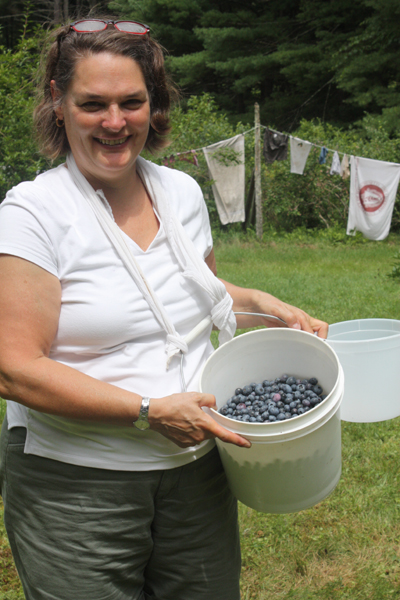
Mom Picks Blueberries for a Pie

My half finished chicken coop still sat on the front lawn around week two. Nothing motivates me more to finish a project than actually needing the structure to put chickens in A.S.A.P. The frame went up one day, the chicken wire the next, and then the tarp. This is called a two hoop cattle panel coop. Sounds kind of catchy.

On Saturday July 24 Susan and I introduced them to their new, permanent home on the lawn. Why the lawn? The extension cord for the heat lamps can reach until they are old enough to be without extra heat. Twice a day I move the coop onto fresh grass, mostly to manage their manure. Now they are almost across the lawn and will be entering a pasture where the bucks live. We sectioned off a large part of the pasture with electric fencing so they will be more protected from predators. Hopefully they will wander beyond the coop and I won’t have to move it every day, but they appear to be so lazy and content inside.

Finished Coop with Chickens

I am conflicted with this meat bird breed- Cornish X Rocks. Its qualities are selected specifically to grow fast white meat. This is the breed the large chicken farms use, which is almost all of the chicken in the grocery store. If you have seen the CAFO (Confined Animal Feeding Operation) photos, those chickens are the same breed I am raising. They eat constantly, lie around, and often can barely walk by the end of the eight weeks. They really need medicated feed because of how prone to coccidiosis they are due to not enough space, boredom, stress, and unhealthy habits. Even I had to treat them because they outgrew my equipment so fast. I don’t believe this is “natural” chicken behavior. This is the industry’s response is to America’s high demand for cheap tender chicken.

Despite these downfalls, I have never eaten such a delicious chicken as the Cornish X Rocks. The rewards from the final product are tremendous, but do they outweigh the not so lovely realities before reaching the dinner plate? I’m not sure yet. Maybe in a few weeks I will have a better idea. Until then, my 20 birds are no longer chicks! They have white feathers growing in and weigh at least two pounds. At least they are roaming around on fresh grass every day. What I appreciate most is how much they are teaching me about raising poultry and being responsible for my own livestock.

4 Comments

Filed under Uncategorized

Small Farm, Big Truck

Rawson Brook Farm is very unique. Have I ever mentioned just how small and compact the entire production is? We make 500 pounds of cheese per week in one barn. There is the cheese room that starts to feel cramped when more than three people are in it. There is the milking parlor where three goats come up on the circular stand at a time. The fridge we sell cheese from is also in this room along with shelving, and other equipment. Through an open door is the room where the bulk tank, milk pump, and sinks are located.  I’m leaving out the hot water heater, hoses, drying rack, vacuum dryer, shelves, and hose washer. Efficient is the best word to describe the operation.

Using space as efficiently as possible in a small dairy is very important. Little did Susan know when she built the barns and designed the rooms, that an enormous tractor trailer would be delivering hay, alfalfa, and straw in several years. Let’s just say the narrow driveway and curvy entrance aren’t the easiest places to back an 80-foot truck into.

Well, today was another trial.  The trucks that transport our hay just keep getting bigger and our farm stays the same. It took the trucker about ten tries over half an hour to back up close to the barn, but he couldn’t make it far enough to the barn door where we were stacking the straw. So, we carried each bale. 550 of them, I might add.

Like always, everything worked out fine. What I like most about unloading the trucks is how every crew of people is different and how great it feels afterward to see the empty barn become full of the straw we stacked together. It’s so easy to worry about anything. The mind just goes there when such a large amount of stuff has to be moved from one place to another. Will there be enough people? Will the truck get lost? Will the trailer not fit? Is the hay going to be wet and moldy?

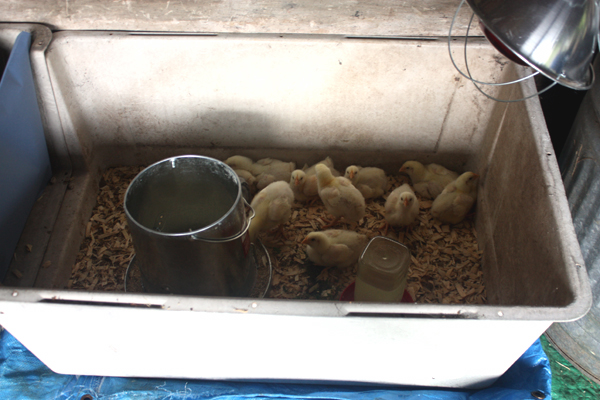
Chick Brooder (1 week old)

Surprisingly, once we get a good system going, it takes less than an hour to do the job. I think every one is relieved once the work is done and loosens up a bit. We start laughing, telling jokes, drinking iced tea, and introducing ourselves for the first time. The tension lets up and our faces are more relaxed. It’s like how travelers get chatty after the plane has landed safely.

Exotic Baby Chick

Exciting news: I received 25 baby chicks in the mail from McMurray Hatchery in Iowa about 12 days ago and they are doing great. I lost 4 due to stress, temperature fluctuation, and cheap food, but I am learning a lot. They are growing quickly as the Cornish X Rocks are designed to do for tender meat in about 8 weeks.

The one “rare exotic chick” comes free with the 24 meat birds we ordered.  He grows much slower and acts a little more like a chicken than the others. What’s it like for him being the small chick that doesn’t look anything like his buddies?

5 Comments

Filed under Uncategorized

From Seed to Salad- Egg to Quiche- Milk to Feta

I am learning to tell stories. It is a good practice to be animated and excited about something I want to share with people. It is also useful to have them listen to me and learn from me. I have been telling what we’re calling the “Chicken Stories” to Susan every so often. Before we are able to discuss plans for the day, I boast with, “Susan! I have a chicken story for you!” She usually stops what she is doing and pays full attention while I share the simple joys of raising hens.

The best one yet is: When I looked out the window, I noticed one of the chickens had lost all its feathers and was very small. Oh no! What happened to her? Something has attacked, she’s sick, all these horrible thoughts raced through my mind. But no, I looked closer and all seven…I mean six were there. Seven? I only have six hens. I walked out the door and I was not imagining a seventh bird at all. It was a male grouse beautifully displaying his tail feathers. He was attempting to attract a female chicken, but they were not the least bit interested. Plus, the hens are twice the size of the little guy.  Rejected.

Would you believe that as I was writing this I got up to move my bike and there were two turkeys on my lawn with the hens?! It’s definitely a bird friendly environment out here.

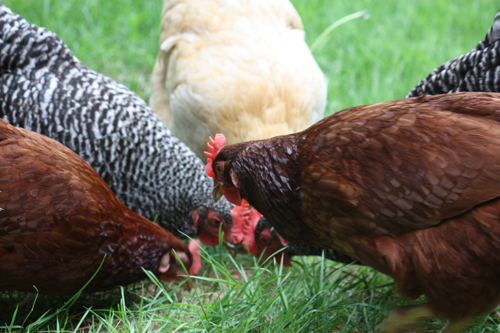
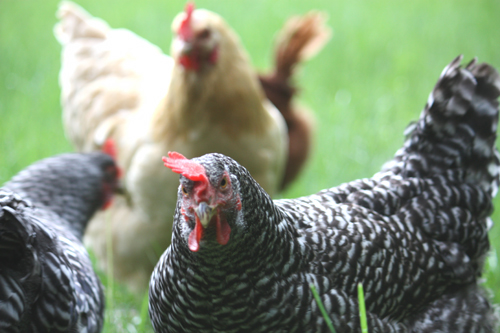
My hens are as good as can be. Roaming around free all day eating bugs, grass, and an occasional strawberry thrown from my porch. They live quite a life. I am getting about five eggs per day, which inspires me to learn new recipes (like quiche…can you believe I had never made a quiche until yesterday?). I also give Susan and co-workers eggs because I can’t possibly eat 35 eggs each week. Craig helped name them last week: Gertrude, Jezebelle, Rita, Buff, Chana…I forget the sixth name. Trying not to get too attached.

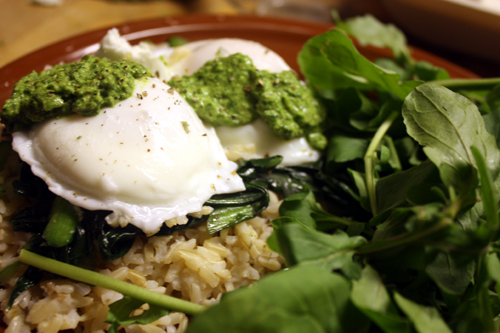
Layering Brown Rice, Bok Choy, Poached Eggs, and Arugula Pesto

Food! Yummy, delicious, fresh garden food! We have planted just about all the garden and are eating greens (spinach, lettuce, arugula, tot soi, mustards, beet greens), bok choy, and herbs.

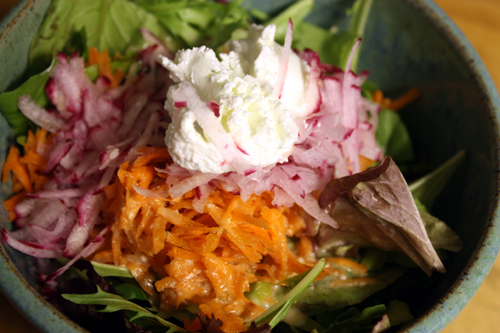
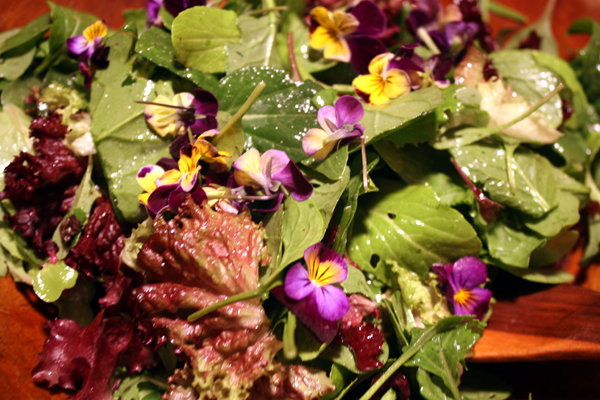
Garden Salad with Shredded Radishes and Carrots Topped with Chevre

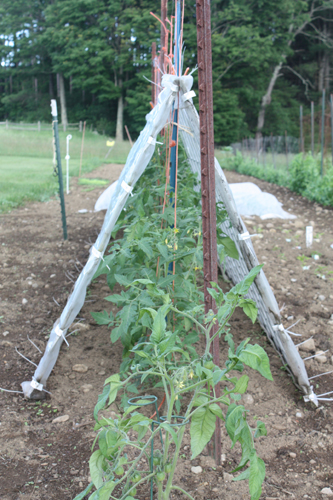
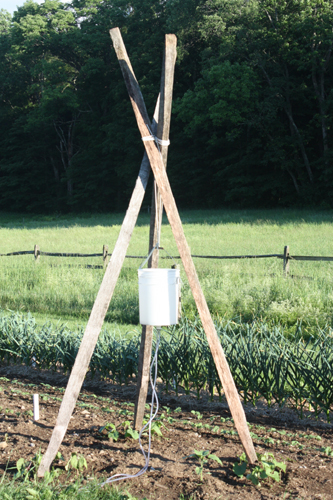
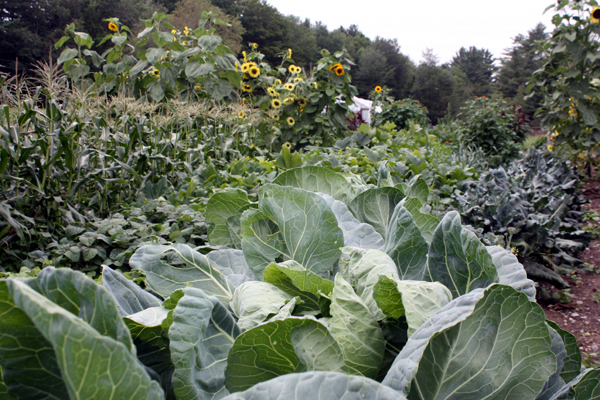
Half our tomatoes are in the greenhouse and the others are outside under a tent we built last spring to provide extra warmth and wind protection.We set up a carrot water system using a bucket with drip irrigation because as we learned from all the rain last season, carrots love water! Pole beans are planted at the base to climb up the tripod. I planted 25 raspberry plants that are doing really well showing lots of new growth. The corn germination is the best yet so we have to thin and weed it soon. Knee high by the fourth of July, Susan says. The garden is in great shape and I look forward to all it provides.

Tomato Tent

Carrot Irrigation System

Feta Hanging in Cheese Cloth

Working at this farm has many perks. One of which is when we have extra milk, there is the luxury of making raw goat milk feta. We have perfected our feta. It is magnificent, like, how can food taste so good? Oh yeah, salt and fat.

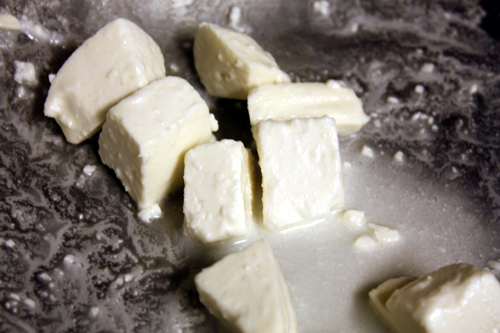
This batch I made all on my own and hung to drip the whey in my kitchen. After about two days of hanging, I cut the curd in one inch chunks, add salt, and it’s ready to sprinkle on salads and stir-fries. The chickens love the to drink the whey and I love to eat the cheese, so nothing goes to waste.

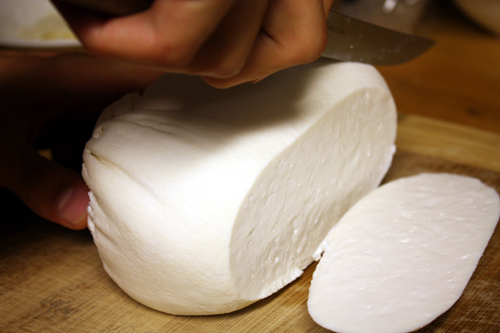
Cutting Curd

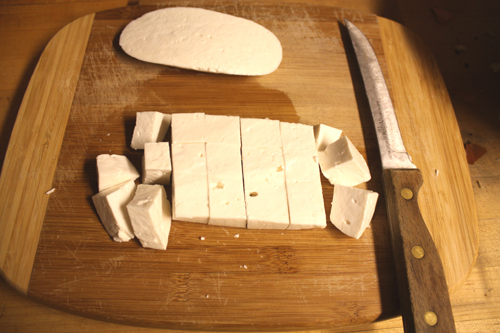
Cubed Feta

Salted Feta

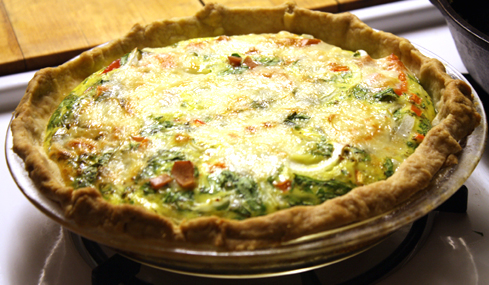
Spinach Feta Quiche

As an appreciation to all my readers, I will share a salad dressing recipe that is being passed around the farm. It gets us to eat salad every day, hence “salad frosting.”

FRENCH DRESSING A LA GLYNIS (A.K.A SALAD FROSTING)

1/2 cup olive oil…the light kind is best

1/2 cup canola oil

½  cup water

2 Tbsp cider vinegar

1 ½ Tbsp honey

1 Tbsp brown mustard (like for hot dogs, brown  is better than the yellow)

1 tsp minced garlic…through the press or  VERY finely chopped

½ tsp paprika

1/2/tsp salt

¼ tsp black pepper

PUT IT ALL IN THE BLENDER

Or if no blender you can whisk it a lot….

1 Comment

Filed under Uncategorized

A Major Milestone

photo by michael jacobson-hardy

Where did the month of May go? I am proud to say one thing I know for sure happened in May was my graduation from UMass. I graduated with high honors and received a bachelor’s degree of individual concentration focusing on sustainability and environmental justice. The ceremonies were somewhat anticlimactic since I have been off campus working at Rawson Brook Farm for a year. But, knowing I am free from the university is quite a relief. I am very proud and feel accomplished because I struggle with academia. We didn’t always know if I would finish, but now I can proudly say I am a college graduate.

“Now what?” is the big question my relatives and friends ask. I chuckle, then respond with a different answer each time such as, “keep on farming,” “learn how to do more stuff on a tractor,” “speak Spanish,” “hike the AT,” “go back to Latin America,” “try to be free,” “fight all forms of oppression,” “raise chickens”… the list goes on.

photo by allyson

The truth is I don’t have it all figured out and I don’t want it that way anyway. As long as I have what matters to me most, like the things listed above, and supportive people to share with, then I’ll be happy. I want to keep my life simple and enjoy every moment. I want to continue learning and building strong relationships. I want to work the land and eat good food. I want to challenge myself to strive for mental clarity so I can make meaningful decisions that positively impact my community. I know these are more complex than they sound, but what more would I want than to live a long, full, rewarding life? What happens along the way whether it’s today, next week, next year, or in 20 years is all a beautiful mystery I patiently and openly embrace.

Although it is easy to get sucked into thinking about the past and future after graduation, I try to focus on the special individual moments as much as possible. Hearing multiple people say how inspired they are watching me design my own major and create what I wanted out of college felt incredible. “Hannah did it her way,” my Dad said. “And she’ll keep on doing it her way.”

Having a family that supports my counter-cultural, not the norm approach to life is something I cannot take for granted. My Mom asks with all seriousness, “When are you going to start your own farm?” What? She actually believes I am capable of doing that and encourages me to go after my biggest goals. How many parents are proud to see their daughters strive to be a farmer? They are a special, special pair. I could not have done any of this without them.

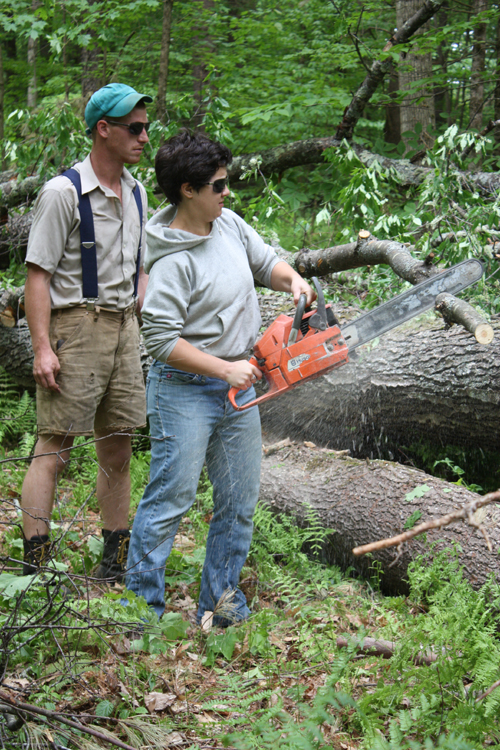
Another great moment was watching my dear friend Amy learn how to use a chainsaw. She really had to trust Mark, her teacher. I really had to resist my motherly comments and just watch the event. Everyone came out of the woods with all their limbs and Amy felt how empowering it is learning to use a new tool that makes lots of noise. There is something so right about showing women how to do things typically men do. I loved the big grin on Amy’s face after sawing up parts of a fallen cherry tree.

Memorial Day Parade photo by elizabeth

Coming back to Monterey after graduation festivities was like coming home. My chickens were happy to see me and followed me around the yard. My cat wouldn’t let me put him down. The goats are all trained for milking and the babies seem to grow a few pounds per day. Craig cooked me lunch and we ate on the porch watching a mother bird feed it’s babies in the nest. Mark and I went fishing at Lake Garfield, he caught a fishing rod on the bottom of the lake and I caught one boney perch. Susan and I planted the garden and are praying for a good rain. Glynis and I packed pounds and pounds of cheese for the big weekend kicking off summer. Michal and I cleaned barn every Saturday discussing immigrant farm politics, beekeeping, and the weather.

What a good life I have. And there are many more good things to look forward to whatever they may be. Now, I will go milk the goats. What happens when I am done and they are back in the barn munching on alfalfa is a mystery.

2 Comments

Filed under Uncategorized

Seasonal Supper Celebrating Spring

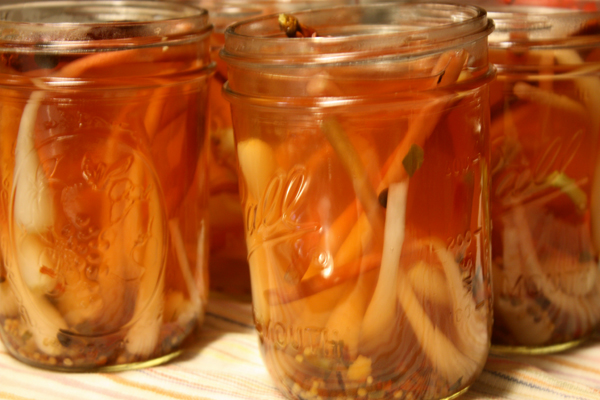
Ever since the ground has thawed, I have been eating very, very well. I ate so many ramps that I don’t want to even look at them anymore. I even pickled them to enjoy in a few weeks or months. Their leaves are beginning to turn yellow as their season ends with the warmer weather. Now, we’re harvesting salad greens from the greenhouse, perennial herbs, asparagus and spinach galore.
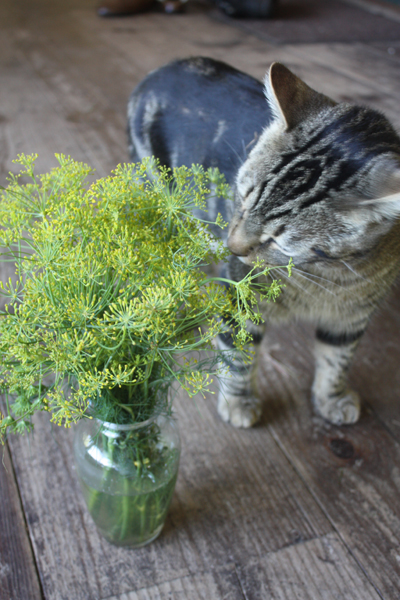
To celebrate the longer days and a reminder that once again, plants will be growing everywhere, we had a spring wild edibles feast! The idea originated from Susan suggesting we make cheese soufflé with all the eggs we’re now getting from the chickens. Then, we added cowslip, or marsh marigold greens to the menu, invited some friends, and next thing we knew it was a multi-course seasonal supper.

To start, we nibbled on two cheeses (one goat and one cow) from Rubiner’s and red wine.

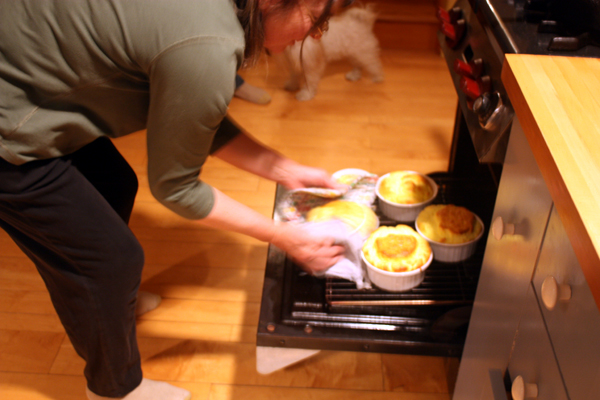
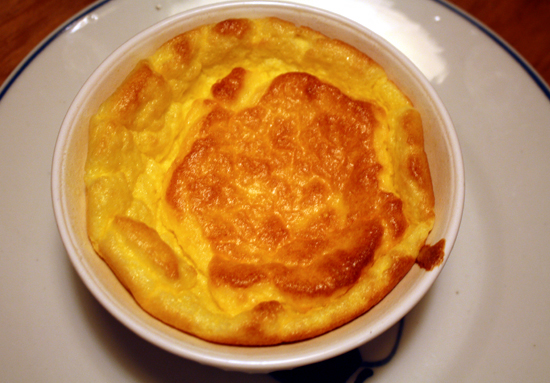
Then, I made a cream sauce, which was folded into egg whites and twenty minutes later cheese soufflé puffed over the sides of a small white dish.

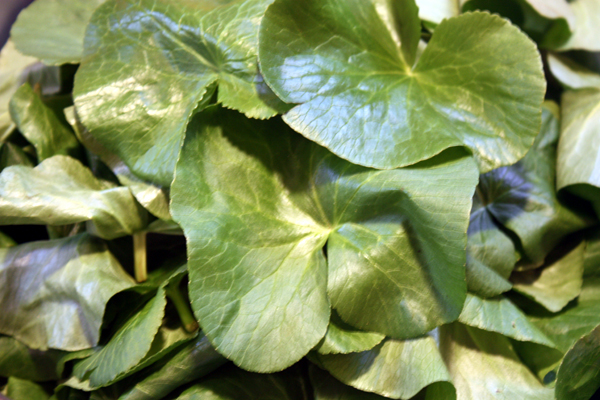
Earlier that day Susan showed me where the abundant marsh marigolds claimed their territory. We picked their shiny heart-shaped leaves to steam and a few yellow flowers for a bouquet.

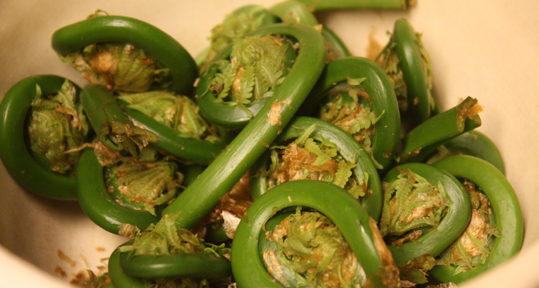
On my way down to help cook the meal, I stopped along the side of the cabin driveway to pick fiddleheads. The ostrich ferns have decided they love the same environment as the poison ivy, but I braved onward and took the risk. I’m not too allergic, and the leaves were tiny. But, I’ve heard this is when their oils are strongest so beware. The steamed fiddleheads with melted butter were worth the poison ivy danger, and I am not itching yet.

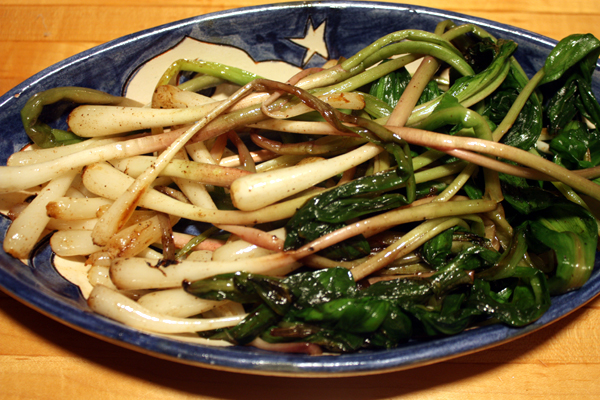
Ramps fried in butter and lemon juice were a must.

A large garden salad (about 20 different varieties of greens) with Glynis’ dressing is always perfect after a meal because it actually settles the stomach and makes me feel less full.

Our after dinner drink was a cold smoothie consisting of blueberries and strawberries I froze last summer, Gould Farm maple syrup, goat milk, ice, and lemon juice.

What could be better than fabulous, fresh, seasonal food combined with good company?

1 Comment

Filed under Uncategorized